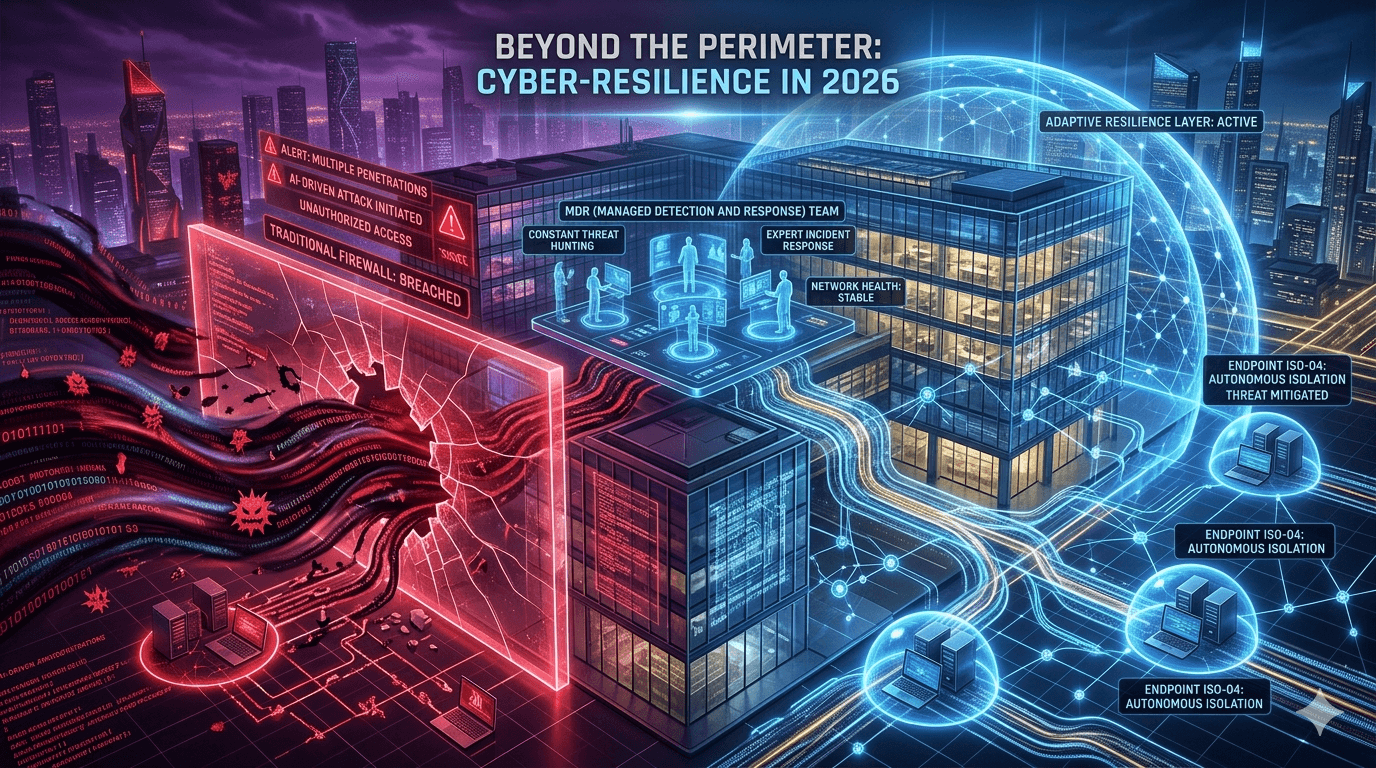
In the rapidly shifting digital landscape of 2026, the old mantra of "keep them out" is no longer a complete strategy. While traditional Cybersecurity remains the foundation of your defense, the conversation has evolved toward Cyber-Resilience.
If cybersecurity is the lock on your door, cyber-resilience is the ability of your house to remain standing and functional, even if a storm breaks a window.
Cybersecurity vs. Cyber-Resilience: What's the Difference?
Understanding the distinction is critical for business continuity. In 2026, threats are more automated and persistent than ever, making a breach almost a statistical "when," not an "if."
- Cybersecurity focuses on protection. It aims to reduce the risk of a successful attack by hardening the perimeter, managing identities, and blocking known threats.
- Cyber-Resilience focuses on survival. It acknowledges that no defense is 100% foolproof. It combines protection with the ability to detect, respond to, and recover from an incident with minimal impact on operations.
Why a Firewall Isn't Enough in 2026
The "firewall-only" mindset treats security as a static barrier. However, modern attackers utilize AI-driven social engineering and "living off the land" techniques that bypass traditional boundaries. Relying solely on a perimeter leaves a soft middle where, once an attacker is in, they have free rein over your data.
A resilience-first mindset protects business continuity by ensuring that even during an active attack, your core services remain online.
Building Resilience with Sophos: A Multi-Layered Approach
Sophos has moved beyond simple antivirus to provide a fully integrated, synchronized security ecosystem designed for resilience. Here is how Sophos Adaptive Cybersecurity Ecosystem (ACE) turns the tide:
1. Predictive Protection with Sophos Firewall
The modern Sophos Firewall isn't just a barrier; it's an intelligent traffic controller. It uses deep learning and Xstream architecture to identify and block encrypted threats before they enter the network. More importantly, it shares data in real-time with other Sophos products to isolate compromised devices automatically.
2. Stopping the Breach at the Source: Sophos Intercept X
Endpoint protection is the frontline of resilience. Sophos Intercept X uses advanced EDR (Endpoint Detection and Response) and anti-ransomware technology to stop attacks in their tracks. It doesn't just block the file; it rolls back unauthorized changes to your data so your business keeps moving.
3. 24/7 Vigilance with Sophos MDR
True resilience requires human expertise. Sophos Managed Detection and Response (MDR) provides a dedicated team of elite threat hunters who monitor your environment around the clock. They don't just alert you to a problem; they take action to neutralize it.
4. The Power of Synchronized Security
The secret sauce of Sophos is Synchronized Security. If an endpoint is infected, the firewall sees it and automatically cuts off that device's internet access while the infection is cleaned. This automated response prevents lateral movement - the primary way small breaches turn into company-wide disasters.
The Bottom Line: Resilience is an Investment in Continuity
In 2026, the goal isn't just to be secure - it's to be unstoppable. By shifting to a resilience-first strategy with Sophos, you aren't just buying software; you are building a system designed to withstand, adapt, and thrive in the face of any cyber challenge.
Don't just defend your perimeter. Build a resilient future.